
Contents:

Travel companies are approaching the biggest technological disruption since the rise of the internet. For almost 75 years, travel technology has developed in distinct, predictable waves that brought changes in data control and user empowerment. In the 1960s and 1970s, the advent of Global Distribution Systems (GDS) provided airlines and travel agencies with unprecedented sovereignty over inventory. The end of the 90s and early 2000s witnessed the emergence of Online Travel Agencies (OTAs), which democratized data and granted consumers sovereignty over access and price comparison. The smartphone revolution of the 2010s contributed to a continuous presence so that travel brands could live in their customers’ pockets. Most recently came the Generative AI (GenAI) explosion of the early 2020s, which promised to radically simplify digital discovery.

However, as we analyze the landscape today, we have reached the (final?) next chapter — the Agentic Era. The travel industry is fast moving from search-led discovery to agent-led execution. This article will detail why this year the industry is going to expand beyond the chatbot, how businesses can benefit from agentic AI for travel, and what major nuances there are for travel companies that want to hop on that AI train just in time.
The travel industry is in the midst of an exhausting period known as AI fatigue. In late 2022 and all of 2023, we witnessed the hype caused by the arrival of Large Language Models (LLMs) and Generative AI. Every board meeting talked about conversational interfaces, while every travel platform scrambled to launch a chatbot. However, the initial euphoria has been confronted with a harsh operational reality. According to McKinsey research, although 78% of companies report that they are using GenAI, more than 80% of companies have seen no material contribution to earnings as a result of these initiatives.
For the travel C-suite, this is the Great Generative AI Disconnect. We have spent millions of dollars building systems that can devise a nice, perfectly formatted itinerary but cannot autonomously book a flight. We have been able to put algorithms in place that can provide a suggestion for where to stay in Paris based on a user’s prompt but cannot easily handle a multi-leg disruption when a flight from London gets canceled. Moreover, we have created high-end discovery tools that end up bringing the user back into the same fragmented and high-friction booking funnels that have been inherent to the internet era for two decades.

Source: McKinsey x Skift Survey.
Hence, the evolution from GenAI to Agentic AI in travel & hospitality is an unavoidable response to a fundamental shift in enterprise economics and consumer trust. PYMNTS Intelligence data shows that 25% of consumers are already comfortable allowing an AI agent to completely plan their travel. In travel with it high stakes and multi-transaction nature, where one mistake can ruin a vacation or an important business trip, this trust requires a change in the enterprise value proposition. We are no longer in the business of offering a search interface, but we are in the business of guaranteeing a travel outcome.

Let us guide you through the wise and healthy way towards AI implementation.
Before we proceed to the analysis of the potential impact of agentic AI in the travel industry, we need to make sure we are on the same page regarding the nature of this technological advancement.
To allocate capital wisely and avoid the pilot purgatory so commonly found amidst initial GenAI experiments, travel executives need to comprehend the architectural distinction between AI of the past and AI of tomorrow. The simplest way to conceptualize this distinction is to differentiate between advisors and actors.
While GenAI is a source of well-informed counsel, agentic AI in travel can act as a digital employee. It has the capacity to identify problems, locate fixes, and apply solutions in multi-supplier ecosystems with limited human involvement.
Comparative Architecture: Generative AI vs. Agentic Systems
| Dimension | Generative AI (Advisor) | Agentic AI (Actor) |
| Primary Function | Reactive assistance and research. Waits for a prompt for text or code. | Proactive execution and goal accomplishment. Operates constantly to meet set goals. |
| Reasoning | One-off, prompt-based responses. Unable to easily link many complex thoughts together over time. | Multistep reasoning for complex, interrelated actions. Able to plan, execute, and revise steps. |
| Tool Access | Limited; generally restricted to text generation and closed, pre-trained databases. | Full access to external APIs, graphical user interfaces (GUIs), payment gateways, and legacy systems. |
| Memory | Context-session aware but lacks long-term memory (context window). | Long-term, structured, persistent, and cross-platform memory using vector databases. |
| Human Involvement | Relies on user prompts, assists with creative problem-solving. | Acts independently, adjusting strategies dynamically. |
| Examples | AI-generated reports on travel risks; scenario simulations for demand planning; automated supplier communication drafting. | Full travel process orchestration; real-time rerouting in case of disruptions; self-adjusting inventory. |
Agentic AI in travel and hospitality is distinguished by three main capabilities:
This third capability is the “secret sauce,” which makes agentic AI viable for the travel sector today. The industry is known for its reliance on legacy technology, while an agentic system can bypass the integration challenges posed by fragmented travel tech. For companies struggling with multi-supplier coordination complexity, finding a technology partner that understands this architecture is vital. This is precisely where tech providers such as GP Solutions bring immense value. By drawing on our extensive infrastructure development expertise, we support travel businesses in deploying intelligent agentic layers that can seamlessly interact with both modern, feature-rich, and accessible APIs and legacy interfaces from decades past, bridging the gap with no need for a drastic system overhaul.

One of the biggest challenges to travel innovation — and a major cause of aggravation for CTOs and procurement departments — is the extremely fragmented nature of data within the travel industry. A single consumer may have more than 100 different platforms to deal with in a year, varying from airline apps to hotel booking engines, from local tour operators to corporate expense software. This data is siloed in outdated systems that simply will not communicate at a fundamental level.
The strategic target here is the elimination of human middleware. There is a deep tragedy of operations most businesses will agree with: travel employees currently devote an unreasonable amount of time performing their role as the manual interface between disconnected applications.
Imagine that a corporate travel agent is dealing with a flight cancellation. They would have to look at an email from the airline (System A), access their GDS terminal (System B) to find an alternate flight, get into a mid-office system (System C) to update the Passenger Name Record (PNR), access the corporate policy engine (System D) to ensure the alternative flight is compliant, and finally email the traveler (System E). Humans are serving as the API that the technology is lacking.
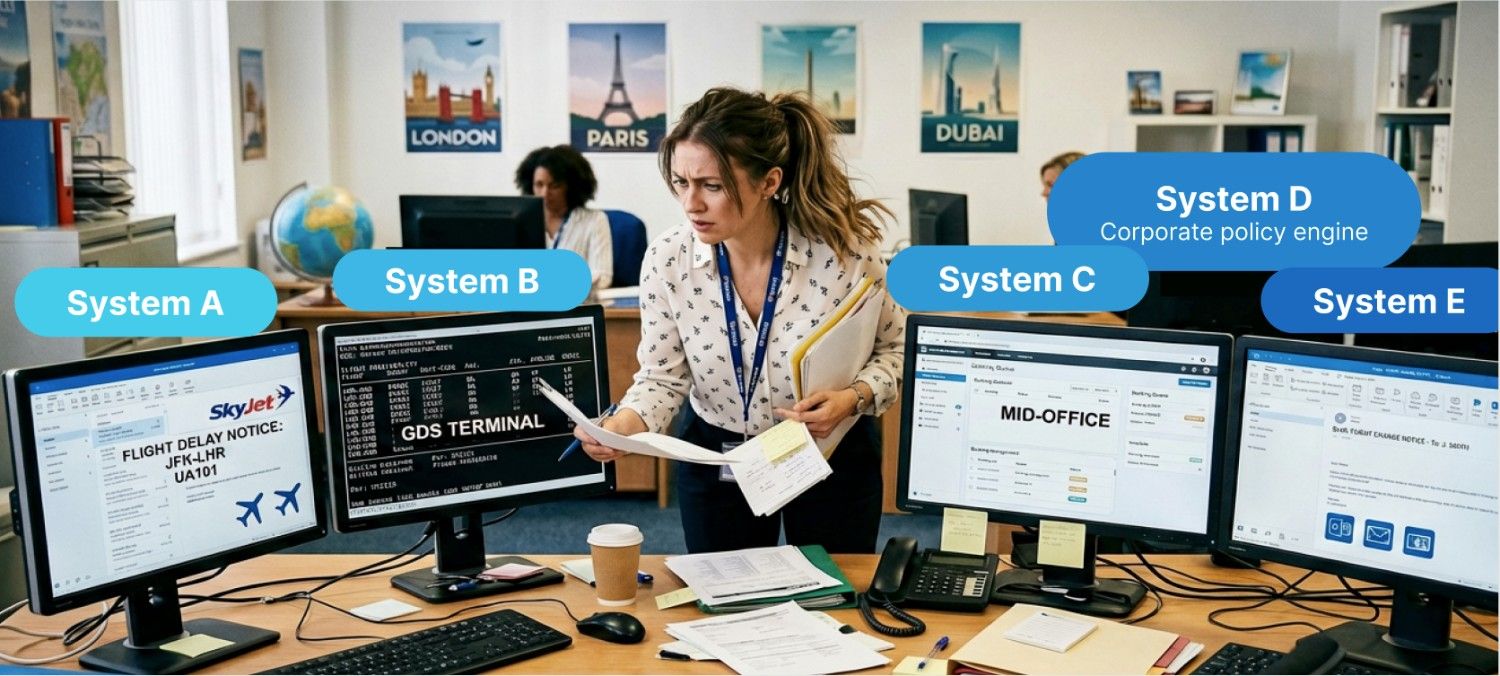
Agentic AI for travel is the connective tissue that can fix the wounds of this legacy fatigue. Because agents can navigate independently across fragmented silos — interpreting both structured data (flight schedules) and unstructured data (support transcripts) — they remove this middleware burden. Unlike traditional automation, which requires perfectly structured APIs, agentic AI in travel & hospitality can act as a human, retrieving or updating data across silos never intended to mesh.
By having tech partnerships with integrators such as GP Solutions, travel companies may deploy these agents securely, knowing that they have the required access permissions to flawlessly execute tasks. This frees up human staff from mind-numbing interpretations and lets them focus on what they are better at — high-touch, empathic customer service.

We are shifting away from the traditional discovery flow workflows (where a user types in a query and is presented with a list of choices) and moving towards execution systems where AI is in control of putting the final product together. Scale is still an advantage for established companies only if they become discovery channels and gateways for autonomous agents, echoed by Booking Holdings CEO Glenn Fogel.
The cognitive load is shifting as well. In the legacy model, the traveler is the main integrator, bearing the burden of comparing cancellation policies and checking loyalty points. We are heading to the autonomous assembly model.
To get an idea of what tangible impact agentic AI in the travel industry may exert, let us have a look at two different traveler profiles:
There are already industry leaders emerging in this space. Expedia has adopted artificial intelligence-driven service agents for resolving booking changes in single interactions, and Trip.com’s TripGenie creates full itineraries and performs directly within the same flow of interaction. The race is on to be the “system of record.”

While consumer-facing bots get the most headlines in the industry, the biggest ROI and lowest risk for agentic AI in the travel industry lie in internal operations. For a travel CEO or CFO, the internal back end is where the most tangible financial impact will be felt for the next 24 to 36 months. Investing here gives an organization a chance to develop “muscle memory” and technical preparedness to expose the technology to high-stakes consumer interactions.
Consider the difference between a simple notification and an agentic action. In a hotel, an existing AI solution may be used to let a manager know a room is ready. Agentic AI in travel & hospitality, however, links to the sensor data in the room, cross-references the Customer Data Platform (CDP) in regard to the next guest’s loyalty tier and floor of choice, and autonomously assigns the room while updating the guest’s mobile key — all without the need for human intervention.
Internal Use Cases and Efficiency Gains
| Operational Area | Current AI Impact (Predictive/GenAI) | Projected Agentic AI Impact (2026+) | Key Differentiator |
| Predictive Maintenance | 10–15% reduction in out-of-service (OUS) time | 20–30% reduction in OUS time | Agent autonomously initiates tickets, orders parts, and creates work plans based on real-time telemetry. |
| Guest Room Allocation | 30 mins saved daily (via static suggestions) | 1–2 hours saved daily (via autonomous execution) | Autonomous real-time allocation and reassignment based on deep, dynamic CDP integration. |
| Housekeeping Management | 5–15% labor hour reduction (via clustering) | 10–30% reduction in hours (via dynamic routing) | Real-time task assignment based on computer vision, guest checkout status, and staff location sensors. |
Related Case Study
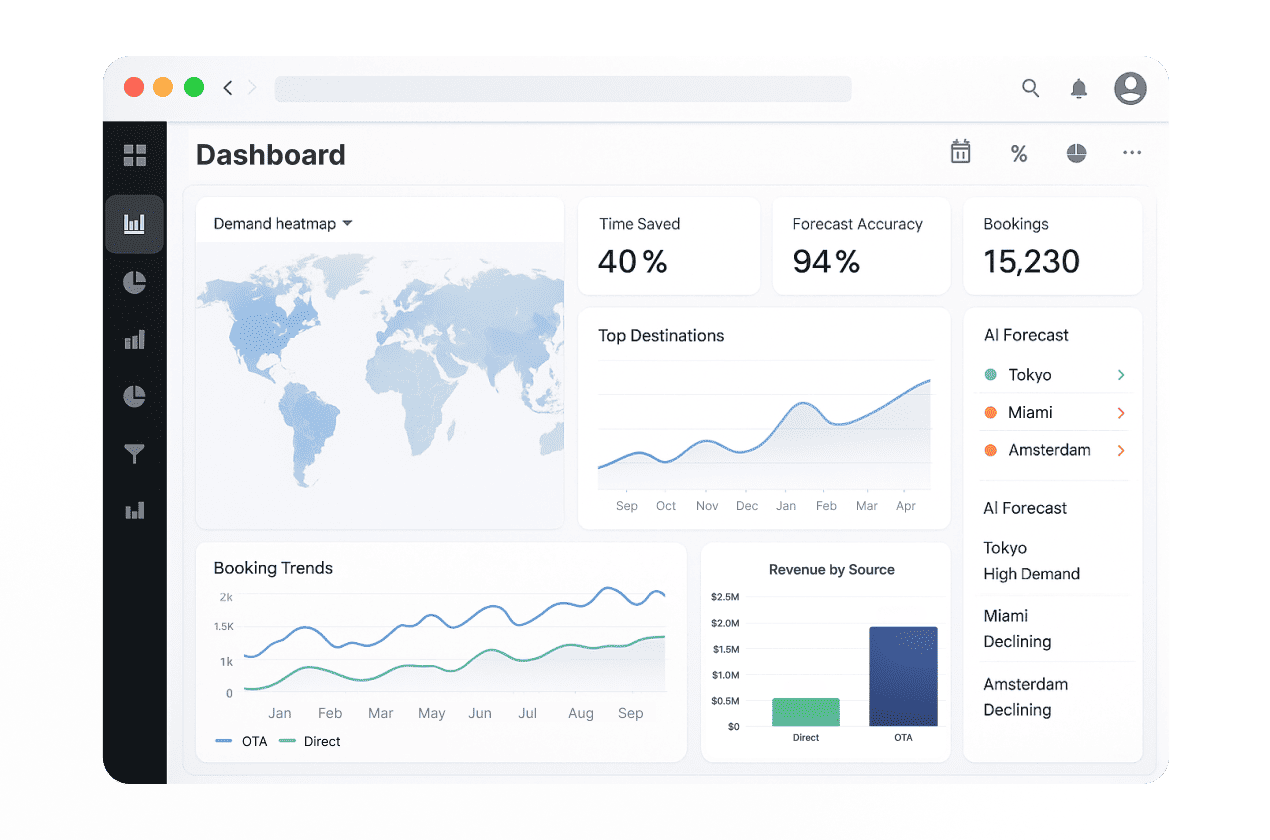
The technical differentiator that will define the rest of this decade is the ability of the agent to store and recall long-term and structured memories. Current GenAI is often transactional: it forgets about the user once the user’s session is over. Agentic AI in travel can keep track of context, progress, and preferences between multiple platforms and sessions.
As Gilad Berenstein of Brook Bay Capital has noted, hospitality is all about perceived value. A hotel employing agentic AI can identify that a returning guest’s daughter loves mermaids and make sure that those specific toys are waiting in the room along with a specific sunscreen the guest preferred on a previous trip to their French Riviera property.
David Neeleman, founder of JetBlue, and CEO of Breeze Airways, emphasizes the power of this data “slicing and dicing.” Agentic AI can easily recognize guests who fly 4x a year but haven’t flown in 6 months and then autonomously carry out highly tailored engagement plans to win them back.

The hard cost associated with putting a mermaid toy in a room or sending a personalized discount code is negligible, whereas the perceived value to the consumer (and the resulting brand loyalty) is astronomical.
The biggest headache for any travel CTO is the clumsy legacy technology that is decades old. You can’t build a modern agentic experience on a foundation that won’t support business needs. If you just take AI and stack it on as you normally would on an old process, you go off track, and you don’t get it working. You have to consider the ripple effect on the whole chain. From fragmented GDS connections to outdated Property Management Systems (PMS), the process of plugging into legacy stuff is the biggest anchor in the industry.
However, a revolutionary approach is emerging — “tech, heal thyself.” Instead of hiring and paying hundreds of consultants to manually update the code over a five-year period, companies are sending autonomous squads of AI agents with special expertise to refactor their architecture.
Related Case Study

Transitioning to an agentic organization involves a full overhaul of the corporate structure from a first-principles viewpoint. In an industry with high turnover, investing in the existing staff and making them true counselors instead of data entry middleware helps to increase stability in the workforce.
All that we previously covered sounds great and almost as if it already has come true. Yet, agentic AI for travel has a long way to go to be implemented at scale.
One concealed reason is that the industry has to adopt common protocols for AI agents from different vendors, locations, and frameworks to communicate properly. The most high-potential protocols for agentic AI in travel include the Model Context Protocol (MCP), Agent Communication Protocol (ACP), and Agent-to-Agent (A2A) Protocol. Until we see transindustrial alignment on this level, true agentic AI for travel will not be plausible.
In fact, the adoption road will not be smooth until truly secure and reliable solutions emerge. Norm Rose from Phocuswright predicts the rise of nefarious agentic AI agents that could trick another agent into sharing a client’s payment details. True agents will rise only when content distribution and infrastructure are ready.

As a strategist, you will be faced with a shocking disconnect in consumer sentiment, the so-called Trust Paradox.
Source: The Global AI Sentiment Report by Booking.com.

Source: US Travel Tracker Survey, 2025.
Consumers are fine with using AI for tasks such as brainstorming (e.g., finding inspiration) but incredibly wary of high-stakes tasks such as visa requirements or financial transactions. This wariness is fueled by well-publicized reports of AI hallucinations.
The path forward is not a big bang release of fully autonomous bots. It is a journey of human-centered, tech-enabled service. AI is not viewed as a replacement but as an enabler, helping employees to provide excellent service. Trust is built through:
Technology has never changed why people travel. Since the 1960s through the rise of the GDS and the arrival of the smartphone, the basic human desire to explore, build memories, and create connections has not changed.
Travel agentic AI would not reimagine the why (and it should not!), but it can fundamentally change the how. It can eliminate the friction that’s plagued the travel experience for decades: the toggling of tabs, the manual re-entry of data, the intense frustration of legacy fragmentation. It can make hyper-personalization truly scalable for the first time by taking the cognitive load off the traveler and the administrative burden off your workforce and moving it straight to the machine.
The travel industry will certainly experience some growing pains, but in the end, agentic AI in travel & hospitality will multiply new opportunities for supplier-direct bookings while strengthening the value of inventory aggregation via OTAs. The companies that are leading the market in 2026 will not simply be those with the fastest algorithms. They will be the organizations that will partner with the experts to untangle their tech debt, build strong agentic workflows, and use AI to be as fiercely authentic to their brand.
One thing is clear: if you ignore this trend, do so at your own peril.
The implementation of AI solutions for travel companies is unavoidable.
We can assist you in your digital transformation with top-tier software experts and travel tech consultants.




Leave your request
We will contact you shortly
Thank you for your request!
We will get back to you as quickly as possible

Get latest insights
from our travel tech experts!
Join 200+ travel fellows! Get GP Solutions' latest articles straight to your inbox. Enter your email address below:
Thank You!