
Contents:

Defining your business strategy without taking into account the latest statistics and key trends in the travel industry is like exploring a city without a navigation map — still possible but would be easier and less risky if you had one.
As we settle into 2026, the global travel industry has passed the volatile revenge travel recovery phase and is entering a period of measured normalization and structural evolution. While the explosive double-digit surges of 2023–2024 have calmed down, we are witnessing a major upward shift in the industry.

Source: Phocuswright.
Travel industry insights indicate that despite geopolitical tensions, high interest rates, and inflationary pressures, leisure and corporate travel supporters still prefer experiences to possessions, which is why travel remains a priority for many.

Source: Skift Global Travel Insights.
The highlight travel industry growth statistics for the past 2025 speak better than words:
However, underlying these top-line numbers, there is an intricate reality. The rebound is uneven, a generational transition is taking place in the technology that enables it to switch from search to autonomous action, and the consumer base undergoes economic changes.
Decision-makers across all segments of travel, including travel and hospitality, aviation, tours and tech, need informed travel industry insights that go beyond the surface level. We are entering an era of digital adoption (which is still a defining force), AI-enabled planning, and a consumer who prioritizes the experience over the possession despite economic headwinds.
We devised this article to aggregate the most relevant travel market insights, projections, and consumer signals and deliver you a grounded view of the global travel trends that can exert the most influence on your success in 2026 and beyond.
While global travel has established itself as one of the most dynamic consumer sectors in the world, travel industry statistics reveal that the rising tide is no longer lifting all boats equally. The frenetic growth of the post-pandemic years has settled down in the mature markets, while emerging regions are accelerating.

Source: Phocuswright.
The landscape of distribution in 2026 will be dominated by a cold war between direct channels of suppliers and the oligopoly of Online Travel Agencies (OTAs).
Regional Distribution of Global Travel Bookings by Channel in 2025
| North America | Europe | LATAM | Middle East | APAC | Eastern Europe | |
| Online Travel Agencies | 30% | 20% | 5% | 4% | 36% | 5% |
| Direct Online Bookings from Suppliers | 35% | 30% | 3% | 6% | 23% | 4% |
| Offline Bookings | 33% | 20% | 6% | 9% | 27% | 5% |

Source: Travel Forward: Data, Insights & Trends for 2026.
The latest trends indicate that OTAs continue to be at the heart of global distribution; as of 2025, they generated about $408 billion worth of global bookings — roughly one in four travel dollars worldwide. However, their power is heavily unbalanced: they are dominant in lodging (the cornerstone of OTA profitability), modest in air distribution, and rather insignificant in cruise and rail.
Despite supplier pushback, OTAs have kept up their stronghold, especially in emerging markets. In India, for instance, more than half of the total online travel bookings are via OTAs, which is much higher than the penetration of this segment in mature markets. In the USA, OTAs dominate the landscape with some $112 billion in gross bookings (27% of global OTA value).

Source: Phocuswright.
Travel industry statistics demonstrate that direct bookings are steady in North America and Europe, where suppliers have been able to use loyalty ecosystems and app-based engagement to win back some share of the online channel.
While the biggest markets still dominate the OTA scale, the next stage of growth is being driven by mobile ecosystems and superapp-style convergence. This can be seen especially in the growing digital economies of Asia. A key example is from India, where travel superapps now include integrated rail, hotel, bus, and financial products, bundling travel products with fintech add-ons (such as Buy Now Pay Later and forex).
Digital adoption is deepest in fast-growing markets. APAC is now the leader of this online growth, with 36% of all OTA sales coming from this region. This puts a crucial shift into perspective: the digital traveler of 2026 is more mobile-first and East-based.

We have been a reliable travel tech vendor since 2002. Our team would be happy to be of assistance.
If the previous decade was characterized by the shift toward mobile, the major travel industry forecast for 2026 is that we are going to witness the onset of the Era of Autonomous Agents. We are in the midst of a shift from generative text (chatbots that talk) to agentic AI (systems that do things).
The search bar, the traditional search tool that has existed for 30 years on the internet, is facing an existential threat. Large Language Models (LLM) such as ChatGPT, Google Gemini, and Perplexity have shaken the discovery upstream. They simplify the logic of browsing dozens of websites into a neat set of individual choices.
But in 2026, it is going beyond simple answers. Enabled by digital identity wallets (projected to reach hundreds of millions of users by 2026), AIs are starting to negotiate, buy, and personalize on travelers’ behalf.

Source: Phocuswright Research Roundup 2H25.
It’s hard to imagine how major OTAs can emerge from this shift in digital trends unharmed. Previously, they did well through disruptive events such as the emergence of the internet and the pandemic, but things are different now. If a traveler can ask an AI agent to “book a hotel in London under $300 near a tube station” and the agent does it directly through one of the suppliers, the OTA’s role as the discovery layer is somewhat reduced.
There are supporters of both scenarios when we may see a significant change in the OTAs’ role or when they have nothing particular to worry about. Hypothetically, LLMs will be able to access OTAs’ and suppliers’ inventory, while hotels could bypass the OTA middlemen and feed LLMs with lower rates directly. Thus, deals could happen outside of the OTA ecosystem.
However, there are several major drawbacks to this scenario happening at full scale. To be cited by LLMs, you need a significant amount of money and effort, which many independent suppliers often lack. Additionally, major OTAs like Booking Holdings, Expedia, Airbnb, and Trip.com have built supply and trust in their brands, while AI users tend to treat AI results with suspicion.
One thing is pretty much solid: the life of traditional travel agency and online travel will not be a good old search bar or hotel listings on a website, as much of travel research will be happening inside LLMs with the output in the form of personalized recommendations.
Vibe coding has all the chances to become a major disruptor in software development in terms of its democratization. For years, innovation in travel was hampered as only the well-funded travel startups could afford engineering teams. In 2026, we may see the end to the innovation deficit. Founders are now using tools like Replit and Cursor to build working booking engines and tools in days instead of months.
We may see a tsunami of niche travel startups to cater to specific needs (e.g., small tour operators, niche hobbies, etc.) that were previously not catered to by big tech. As Sean O’Neill from Skift points out: “Ideas that might never have seen the light of day before will finally have a chance to shine.”

While Agentic AI gets the headlines, the winners in 2026 are the companies that are mastering the boring back end.
AI needs clean data. It is not possible to have a smart AI agent if your back-end data is messy. OTAs and suppliers are realizing that hotel and room mapping (making sure that a Deluxe King is identified correctly across all channels) is no longer an IT task but a strategic priority.
Agentic AI is only as good as the logic of its decision-making. Without a foundation model for predicting demand with extreme precision, an autonomous agent will be making the wrong calls with confidence such as wrong prices for rooms or wrong allocation of inventory.
Successful companies are not automating everything. They are automating high-friction workflows such as supplier onboarding and rate validation, while leaving complex service issues to humans.
In 2026, hyper-accurate forecasting coupled with the explainability of an LLM can evolve AI from a system of record into a true system of action.
For three decades, travel marketers have been playing by Google’s rules: master the keywords, build backlinks, and climb the page rankings. In 2026, those rules are being rewritten on the fly. We are now in the age of Generative Engine Optimization (GEO), where the goal is not to be ranked high but to be cited in the answer produced by AI.
Global travel trends in terms of marketing show that the funnel has changed. Travelers of today are no longer simply clicking through ten blue links. They are getting answers right on the results page. Zero-click searches (where the user sees the answer and clicks nothing) increased to 26.7% in late 2025. Traditional organic traffic is declining for many brands — down 30–40% for some DMOs (Destination Marketing Organizations) — as AI platforms are answering travel queries directly, without redirecting them to the source website.
In such an environment, visibility is dependent on whether LLMs trust your brand enough to include it in their synthesized answer.
Forward-thinking marketers are now creating content structures (schema markup, verified data feeds) specifically for LLMs such as ChatGPT, Gemini, and Perplexity to “read” easily. As Miguel Sanz of the European Travel Commission pointed out, “We’re spending more and more on having content . . . that LLMs can read.”
Expedia’s Science of Wanderlust survey found that video is almost three times more influential than images when it comes to making travel decisions. Crucially, video content is also increasingly being indexed by multimodal AI models, which is another dimension for bots to “watch” and recommend.
As said, the new goal isn’t about ranking higher. You need to be in the answer. Brands will have to make sure their content is structured, verified, and machine-readable so that it appears within AI-assembled summaries.

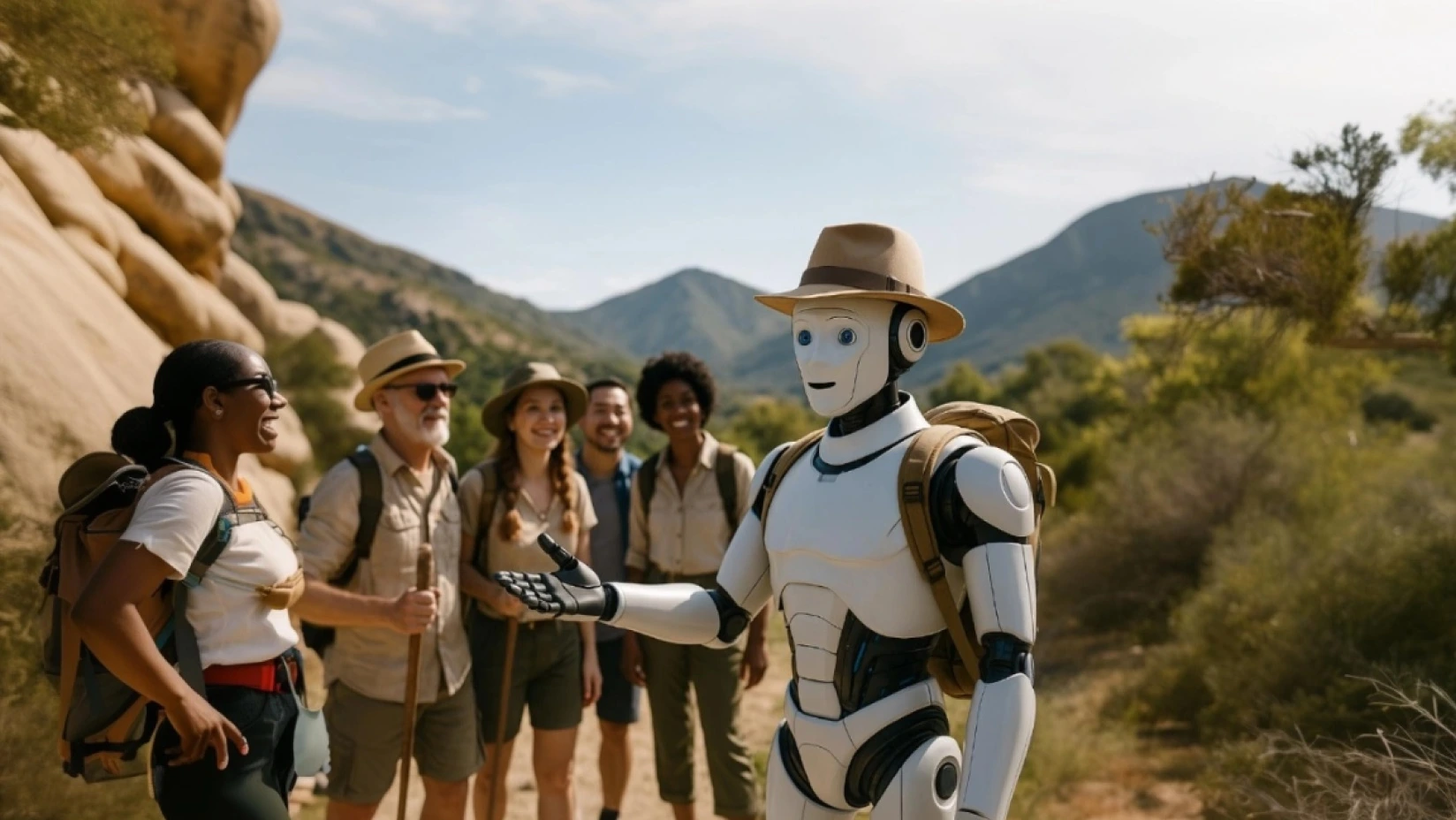
Who is the traveler of 2026? They are paradoxical: digitally dependent yet wanting disconnection; value-conscious yet willing to spend so much money on experiences.
Amidst travel industry trends 2026, one stands out — the need for silence. New terms emerge such as Quietcations and Hushpitality that focus on comfort, silence, and escaping the compounding stresses of modern life.
With the reality of a 24/7 digital culture colliding with real-time global crises, travellers are looking to disconnect. This is driving an appetite for off-grid locations — places such as Toledo (Spain) or Northumberland (UK) which promised an antidote to the over-filtered Instagram hot spots.
While AI is the headline, its adoption is all over the board by generation:

A new behavior has emerged called Travel Mixology — a push-pull dynamic in which travelers use AI to do the heavy lifting (sorting options) but retreat to human sources for trust.
This phenomenon is caused by the trust deficit, with 25% of travelers saying they have been given out-of-date information from AI, and the explosion of deepfakes on the internet.
Travelers are backing up AI suggestions with human reviews (e.g., Reddit, social media) prior to booking. Brands have to play on both sides: play the game of optimizing for AI visibility while building organic, real-world content that gives synthetic output human sticking power.
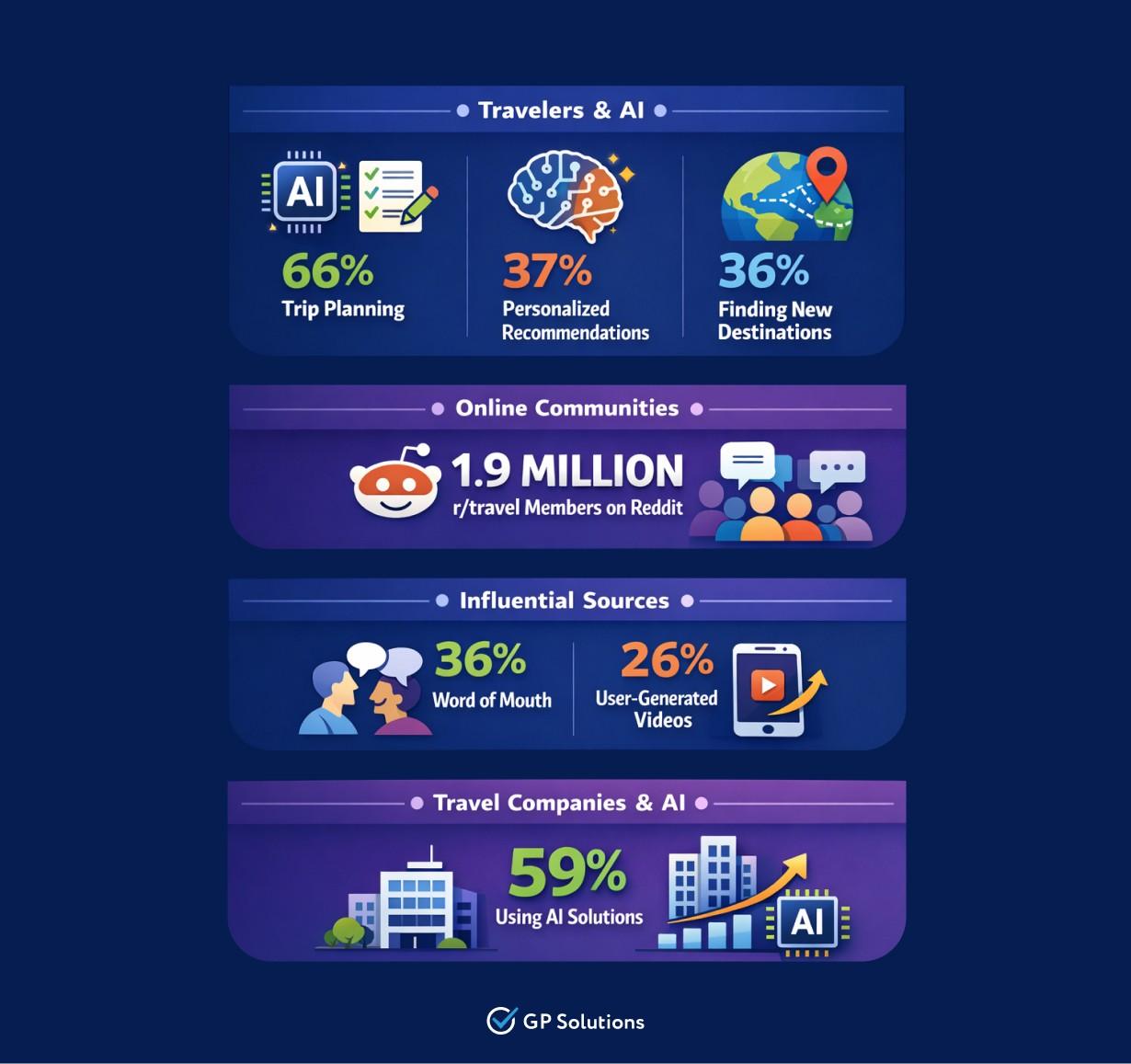
Sources: Search Slips, AI Surges: Travel’s New Front Door? and Amadeus Travel Trends 2026.
If the economy is stabilizing, then why does it feel different? Because the travel industry is splitting in two, as global business travel trends suggest. We are seeing a Capital-K recovery where the wealthy pull away from the rest, becoming the industry’s load-bearing wall.

Source: Skift Global Travel Insights.
The gulf between the haves and have-nots is widening, and travel businesses are tuning their strategies accordingly. The top 10% of earners now take up almost 50% of spending in travel and leisure. Experts talk of the term “Indulgent Explorers”. This segment accounts for a small portion of the market, yet a disproportionate portion of the revenue. Indulgent explorers value variety, and they heavily depend on trusted human expertise (travel advisors) to navigate complex itineraries.

Source: U.S. Consumer Travel Report 2025.
Businesses are following the money, and the focus is shifting from volume to yield.

Source: Fortune Business Insights.
Global business travel trends suggest that luxury in 2026 will be expanding beyond the norm of five-star resorts. The new luxury traveler is looking to feel, not be seen.

Resource: Skift Research 2025.
When an industry relies heavily on the top 10% (or top 1%), it is vulnerable to that cohort’s feeling. However, global travel trends suggest that high earners are more stable in their jobs and have more cash reserves, meaning this segment is not very sensitive if the rest of the economy stumbles.
Related Case Study

If the previous years were about digitization, 2026 is about autonomy and identity. The technology landscape can be summarized by three different vectors, namely: Agents, Biometrics, and Chatbots.
Everyone in travel is talking about AI agents and for good reason. We are moving from tools that help you work to tools that work. Even though less than 10% of travel companies had scaled AI agents by 2025, 40% of hotel chains planned to implement them this year.
These agents do more than just simple queries. They are capable of reasoning, i.e., negotiating a refund, rebooking a complex itinerary in the face of a disruption, or managing yield forecasting without human intervention.
We are moving to a time when your primary customer might not be a human being but an AI agent that is acting on behalf of a human. Your API is now your most significant storefront.

Source: McKinsey and Skift Survey.
Biometrics have ceased to be a security novelty and have become an operational necessity. And the consumers are ready: more than two-thirds of travelers say they’d be willing to use biometric gateways to make their journey faster.
Biometrics is closely tied to digital identity wallets, with hundreds of millions of travelers expected to adopt them by 2026. These wallets will contain verified credentials and payment details, making it possible to book across multiple suppliers with a single agent-driven click. Identity is the trust key that enables the agentic economy to scale safely.
The chatbot of 2023 was a frustration; the chatbot of 2026 is going to be a concierge. The latest iterations (powered by GPT-5 class models) are context-aware and combine together reasoning, speech, and vision. In demos like Google’s Project Astra, travelers can ask questions about what they are seeing through their smart glasses and get instant, spoken context.
Chatbots and virtual assistants have become the leading business area where hotel chains are harnessing the powers of AI, transforming from cost-saving support tools to revenue-generating sales channels.

Source: Skift Research.
Looking for a tech partner to harness the digital transformation of your travel enterprise?
As we navigate 2026, there is a recovery taking place within the travel industry, but it’s a re-architecting. The rising tide of post-pandemic demand has become the norm, and there is now a bifurcated landscape.
On the one hand, you have the Capital-K recovery, carried by the high-net-worth and a booming luxury sector that requires hyper-personalization. On the other, you have a technological revolution where AI agents, vibe coding, and digital identity are breaking up the old distribution oligopolies.
For the C-suite, to be successful in 2026, it is important to execute on four strategic pillars:
The map for 2026 is drawn. The technology is active. The demand is there. The only variable that remains is how quickly your organization decides to navigate your way through it.
GP Solutions can be your pathfinder along the journey to a better technical self for your company. With years of experience in travel tech and projects spanning travel startups and multi-brand groups of companies, we offer the deepest domain expertise and the readiness to push innovations further. Reach out to our travel tech consultants to find tech solutions to the problems that are haunting your success.



Leave your request
We will contact you shortly
Thank you for your request!
We will get back to you as quickly as possible

Get latest insights
from our travel tech experts!
Join 200+ travel fellows! Get GP Solutions' latest articles straight to your inbox. Enter your email address below:
Thank You!