
Contents:

Online is absolute dominance, and no ambitious tour operator can exist without a sleek and user-friendly travel website where a user can easily select and book the journey of a lifetime in a matter of a few clicks. Over 70% of travelers now go for digital platforms to manage their trips and payments, pushing travel businesses to adopt and develop multi-faceted software covering a multitude of activities performed by tour operators on a daily basis that remain invisible to the end-user. Most of these activities are processed by back-office applications, and it may be quite difficult to grasp the logic behind them on your own.
Travel websites managed by tour operators are not what they seem and require quite an effort from a team of professionals — web designers, front-end developers, HTML editors, and more. However, whenever you look beyond the front end, you’ll realize: what you’ve seen is just the tip of the iceberg.
We created this article to take you on a guided tour behind the scenes and present a modern tour operator back office to you in a digestible and clear fashion. We’ll also dig deeper into modern development trends for tour operators and some noteworthy setup peculiarities.
Let’s go!
The global tour operator software market brought in around USD 878.9 million in 2024 and is projected to grow to about USD 2.47 billion by 2034, at a 10.9% CAGR, driven by online booking growth, cloud adoption, and demand for automation. Alternative estimates place the market at roughly USD 1.2 billion in 2024, reaching USD 3.5 billion by 2034 with an ~11.3% CAGR. Whichever forecast you choose, they all underscore the sustained long‑term investment potential in back-office and related platforms.
The back office is the key part of tour operator software responsible for all-round business process automation. It encompasses a wide set of apps, modules, and tools, each contributing to their own part of the common cause, which is the efficiency of the tour operator business.
Here is a simplified scheme presenting the structure of a modern tour operator back office:

Even this simplified version may appear quite bulky. But it is just the beginning of the journey. Every element of the scheme hides a world of its own specific functionality. Let us dig a bit deeper into each building block and deal with it in more detail.
We didn’t put inventory first by chance. It is at the heart of tour operator activity, being the unified source of all products and the related content offered to a tour operator’s clients, partners, and end customers. The content may include short and extended descriptions, media files, available services, pricing conditions, and much more. Inventory is also responsible for availability management, whereby tour operators define, for instance, how many rooms, tickets, and boarding places are offered for the given product over the given period of time.
The critical role of this module is reiterated by research data revealing that in 2024, Europe alone held more than 35% of global tour operator software revenue, with online booking modules accounting for about 45% of market share, followed by CRM (~30%) and inventory management (~25%). Inventory modules increasingly support dynamic packaging and real‑time availability from multiple external suppliers, which is a core reason software spending is rising.
Modern travel inventory is typically filled in three basic ways:
A tour operator’s employees input the data about the products sold by this tour operator by hand.
A back-office system connects to various third-party travel supplier APIs to receive information on product availability in real time. API-based sourcing is particularly critical in this case as online booking platforms and OTAs scale and need near real-time updates across accommodation, transport, and activities.
This is the option for suppliers who don’t have their own API for automated integration. In this scenario, a supplier’s employees receive access credentials to the back office to create and manage their products manually.


We build travel software that solves the core challenges of tour operators.
This functional block contains a set of means to store and process all incoming booking requests by assigning them to responsible individual managers or teams. It also contains sophisticated filtering and listing capabilities, allowing you to sort lists of bookings by time/date, sales channel, supplier, responsible manager/service team, and many other parameters.
Modern reservation management is able to process incoming booking requests in different ways:
As travel businesses are making all possible efforts to expand to new markets and reach more clients, multi-channel reservation management (own website, OTAs, marketplaces, B2B portals) is now central, with online booking modules capturing the largest share of software spending.
This part of the tour operator’s back office covers how travel products are sold by the tour operator to various audiences. Generally, there are two key channels:
The B2B-oriented back-office sections may contain the following functional blocks:
Modern back offices often support sophisticated multi-level B2B distribution integrated with dynamic pricing/commission rules, especially for agencies and sub‑agents in growing regions like Southeast Asia and Africa.
The B2C sales section usually incorporates diverse instruments to create customer-facing websites for selling travel services to the end traveler. Modern tour operator back-office solutions allow creating multiple B2C portals that can be set up for the tour operator, its partner agencies and partner tour operators, corporate clients, etc. The B2C section is also normally equipped with an API interface that allows customers to build their own websites with unique designs and integrate them with the back office.
B2B and B2C Interfaces of GP Travel Enterprise

A cleverly designed and managed customer relations strategy is of key importance for any business. For this reason, customer relationship management (CRM) solutions (or just their individual elements) are present in almost every tour operator’s back office nowadays.
CRM solutions serve several important goals:
Tour operator back-office systems can incorporate CRM solutions differently. There can be built-in CRM modules that come as a constituent part of the back office. However, a more popular way is to integrate back-office software with external specialized CRM solutions — the likes of Salesforce, HubSpot, Pipedrive, or others. Common CRM integrations for tour operators include loyalty programs and repeat-purchase analytics, especially for businesses focusing on high-value FITs and corporate customers.

The business rules engine is another important element within a tour operator’s back office. Its purpose is to aggregate and govern the internal logic and commercial conditions of running a tour operator business. In particular, a business rules engine can be used to:

This software segment serves to track financial operations and acquire complete information regarding a tour operator’s financial flows. It normally involves the following items:

The built-in accounting is available to some extent in any tour operator back office. But the common practice nowadays is more often to connect specialized accounting software like Sage, Xero, or other systems for the purpose.
No less important here is the integration capability of your software vendor. Since many travel businesses prefer to have reliable and multiple payment options at hand, especially those striving for global reach, being able to connect to world-class payment systems such as Exactly.com, will be a plus. Exactly takes special care of security and compliance and offers its users high-level personalization to cater to their exact needs. This comes with dedicated human support and proactive performance analysis, helping businesses convert more and waste less.
It is of vital importance for the tour operator to provide adequate payment means and conditions for the travel services provided. All payment-associated activities are usually handled within a specified back-office section where you can configure:

Analytics functionality is one of the most crucial elements influencing the decision-making of tour operators with live data on business performance. It can provide tour operators with instant and exact information on the number of orders made by any given agency and from any given supplier, build reports on the most booked destinations and travel services, and much more.
Modern analytics in tour operator back offices can be built-in or connected from a specialized third-party vendor (JasperReports, Microsoft Power BI, HubSpot, FineReport, etc.). The latter are normally a lot more sophisticated and are powered by the latest advances in BI and Big Data to offer top-notch statistics and analytical data.
More operators now embed real‑time dashboards and BI on top of back-office data, often via tools like Power BI or specialized travel BI suites, to monitor margins, supplier performance, and channel ROI. Cloud-based back offices contribute to risk minimization by centralizing financial data, reducing human error, and ensuring consistency within multi-brand hierarchies and across remote teams.
Related Case Study
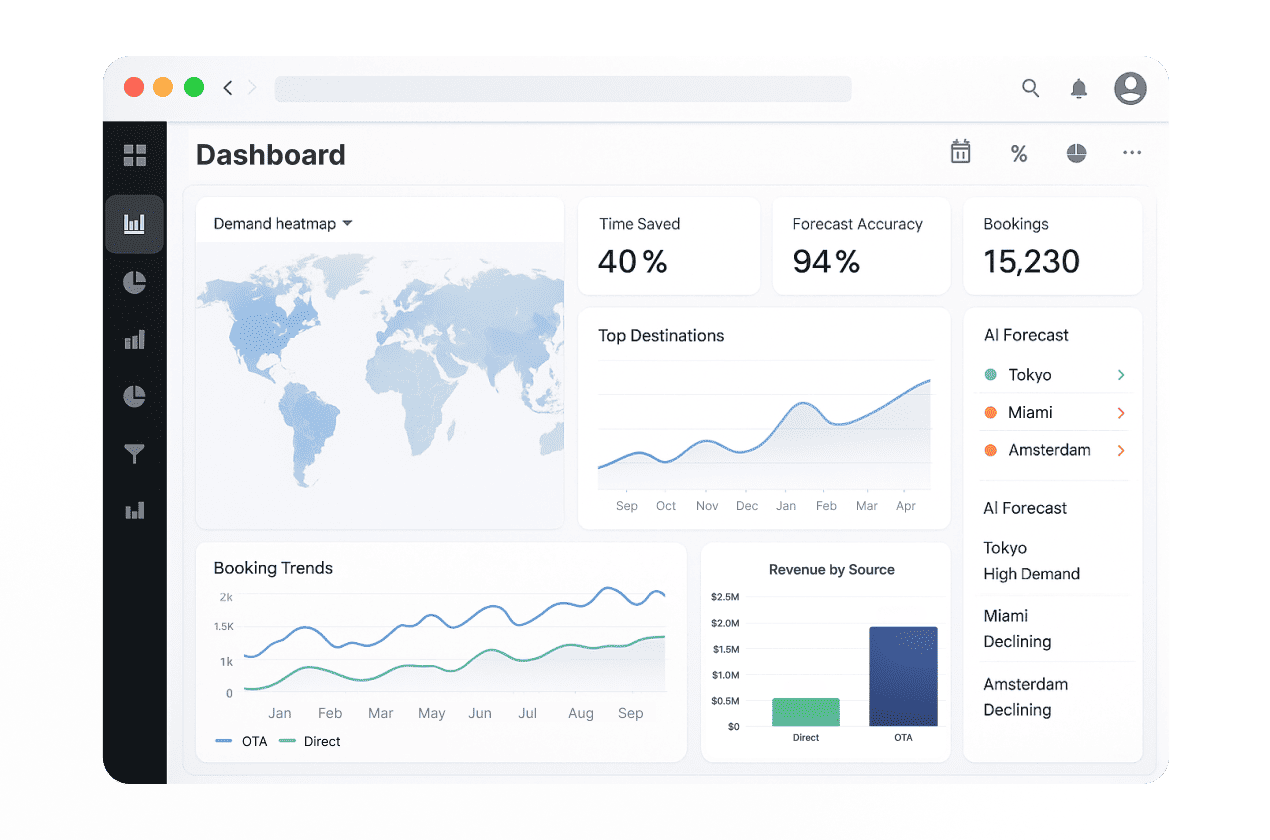
Modern tour operator systems involve a whole world of different users responsible for their own bit of work within the company’s structure: managers, administrators, guides, suppliers, agents, corporate clients’ employee, and many more. It is important to provide them with adequate permission rights to enable them to perform their own bit of work effectively and without intervening with the activities of their colleagues. A separate user management section is normally provided for this purpose. In addition to permission rights settings, it normally provides means to:

Thus, the user management section provides a unified point of supervision over users, making it easy and convenient to execute supervision of their activities.
Adequate and professional customer care is a major prerequisite for strong business performance and building a loyal client base. Modern back-office systems are equipped with various modules and tools to ensure high-quality customer service. The most frequently used ones are:
When combined, they help to ensure quick response times and effective processing of customer requests, which leads to better client retention rates, improved engagement, and higher sales.
As of 2024, Europe held a dominant market position (over 35% share) due to its mature tourism sector, while Asia-Pacific has come out as the largest and fastest-growing region for software adoption. The needs of tour operators will differ not only geographically but depending on their type as well, resulting in significant differences in the setup of back-office systems.
These companies predominantly specialize in arranging trips abroad. For this reason their inventory will not require an extensive CMS designed for creating self-operated products. Most of their bookings come via contracted third-party suppliers, which means their back office should have a well-built section for third-party integrations and Extranet to fill the inventory from external sources.
Outbound tour operators often sell a wide selection of travel products. Hence, a back-office setup for them will normally include several activated APIs per product type. Outbound players typically rely on multiple third‑party API connections to different wholesalers, GDSs, and aggregators and OTA connectivity to handle high volumes and dynamic pricing, making open architecture and API aggregation non‑negotiable in today’s era.
For the purpose of this article, the category of inbound (or incoming) tour operators will also cover destination management companies (DMC) and domestic tour operators since all of them normally specialize in one particular destination and work with a limited set of local service suppliers. They also tend to focus on highly customized experiences with hand-crafted itineraries. Because of this, their back-office setup will have the following distinct features in common:
DMCs increasingly use back offices with strong content and contract management for unique local experiences. Modular architectures can be of special benefit for them as it allows to add new experience types quickly.
These companies focus on independent travelers who need the freedom and the right functionality to book travel services on their own. Thus, the back office for these companies is normally heavily focused on B2C functionality and includes:
OTA‑like operators often demand back offices with self‑service B2C portals, powerful back‑office finance management, and customer service modules, along with deep API connectivity to OTA front ends.
Explore the Capabilities of Tour Operator Software Tailored to Solve Your Challenges

At any period of time, there are clear trends influencing tour operator software development across the technology market. Here are a few that are rattling the travel tech society at large.
Artificial intelligence has moved beyond simple chatbots to become the driving force behind many back-office operations, improving upsell, support speed, and conversion from both B2B and B2C channels. Its application is limitless, with ever more use cases hitting the headlines as we speak. About 46% of travel companies cited generative AI as their top priority for 2025. Major AI manifestations for the back office include:

Rather than be chained to a single vendor’s limited suite of tools, tour operators are adopting Composable Architecture. This headless approach utilizes open APIs to separate the back-end logic from the front-end user experience, covering:
Travel companies often move literally in different directions (remember we’ve discussed earlier the difference in the setup for inbound and outbound tour operators), both logistically and in business terms. Modular architecture is one of the solutions to the conflict between specialized needs and broader software capabilities.
As a tour operator grows to become a complex entity of multiple divisions (Sales, Reservations, Accounting), disjointed data becomes a liability. The trend is towards holistic Enterprise Resource Planning (ERP) solutions, which can serve as a central hub.
Over 65% of tour operators now prefer cloud-based deployment because of scalability, easier remote access, and lower upfront costs, reinforcing the importance of web-based, multi-tenant back-office setups.
Research shows that 70% of travelers actively seek sustainable travel options. To answer this customer demand, tour operator back-office software now includes green tech features:

Global tourism saw a strong rebound in 2024–2025, with expectations of continued growth for 2025–2026, though we cannot cross out some potential regional disruptions. Where there is growth, there is revenue, and it pushes tour operators to upgrade systems to handle higher volumes efficiently.
In 2025 and beyond, the tour operator back office has ceased to be just a database and transformed into an intelligent command center. A tour operator back office nowadays is a comprehensive solution with multiple functional blocks and modules for different needs and purposes. It can also come in various setup versions depending on the specialization of every tour operator. The most competitive operators are those using systems with embedded AI for predictive analytics, integrating sustainability reporting and offering API-first connectivity.
We hope this small guided tour was insightful and helped you form a clear idea as to how a modern back office operates. Stay tuned – there’s more quality travel tech content coming your way!




Leave your request
We will contact you shortly
Thank you for your request!
We will get back to you as quickly as possible

Get latest insights
from our travel tech experts!
Join 200+ travel fellows! Get GP Solutions' latest articles straight to your inbox. Enter your email address below:
Thank You!