GDS System — How It Works, Why It Matters, and How to Choose the Right One
Share
Reading time: 19 min
For a non-expert, it would be hard to believe that travelling today could be way more challenging without Global Distribution Systems (GDS). Yet for airlines, travel agencies, tour operators, and other travel companies that have been using GDSs for over 30 years, these systems are an indispensable part of their daily operations. To understand how the travel industry moves, we need to understand how GDSs connect the world.
In recent years, GDSs have long transcended their historical role as a static repository of airline and hotel inventory and transformed into a dynamic ecosystem, drawing on the latest advances in cloud infrastructure and artificial intelligence. This article provides an extensive overview of frontier GDSs, technological shifts in the distribution landscape, and strategic guidelines on how to use the best GDS system for your travel business.
* This material was created in close collaboration with Yana Brilevskaya, Business Analyst at GP Travel Hub, who shed her expert light on the latest developments for the global distribution market.
GDS. Origins
How do regular travelers purchase their flights? Basically, there are three major options for us to grab a seat on a plane:
We go to our chosen air company’s website and book a flight there for the date we need;
We use air ticket aggregators like Kayak, Skyscanner, or Expedia and search through air offers there, picking the best option for the selected date;
Or we contact a travel agent to do the work for us (or they will do it themselves if we purchase a package tour with them).
To distribute their tickets through all these options AND worldwide, it’s not enough for airlines to have a website — they need a strong tech provider and distributor who will deliver their offers to online travel agencies (OTA) around the globe. That’s when GDSs so eagerly stepped in.
Now we see the reason. But how did it all begin?
It all started back in the 1960s in the USA, when American Airlines and IBM laid the foundation for automatic flight distribution. Its then cutting-edge mainframe IBM 7090 computer was located in New York and stored all the flight information. The machine was connected to around 5,000 American Airlines’ terminals around the country. Your travel agent back then would contact the airline by phone to make a reservation for you. The system was known as the Semi-Automatic Business Research Environment, or SABRE.
Later, similar machines were popping up around the globe, with Sabre at the forefront of air distribution. In the 1970s, terminals were extended to travel agent offices to free up manpower at airlines. And the rest is history.
What Is a GDS System?
A Global Distribution System, or GDS, is an online platform exclusively for companies within the travel industry. It all started with air distribution, as we briefly mentioned above, but with time GDSs were able to connect travel agencies with other service providers such as cruise lines, hotels, car rentals, etc. If some new type of travel emerges in the future, like space travel, we bet GDSs will add it to their inventory asap.
What Key Features Does Any GDS Booking System Have?
However multilayered, a competitive GDS should have its must-have pack of salient features that contribute to effective travel management:
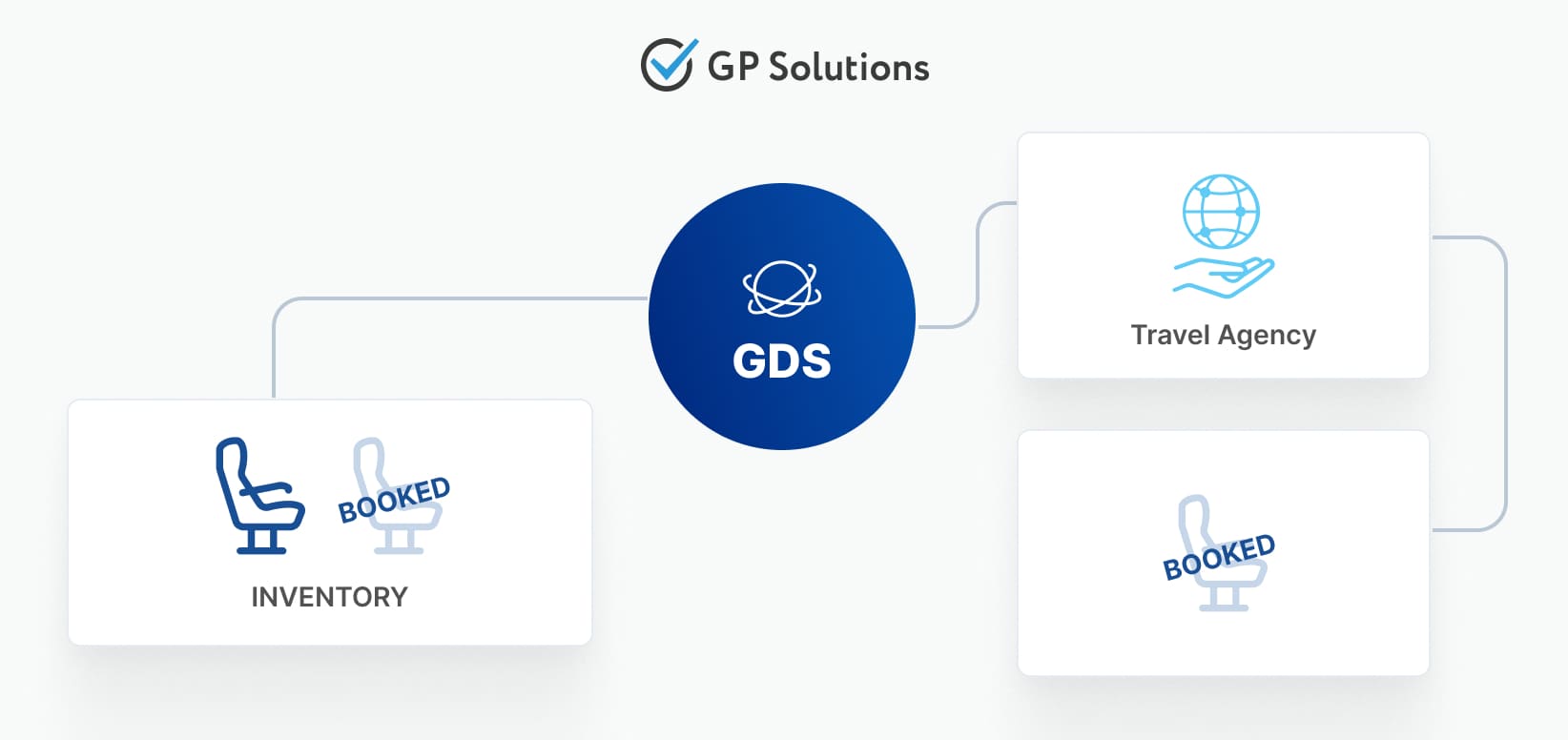
Real-time availability and inventory management: One of the primary functionalities for any GDS is its ability to communicate real-time flight, hotel, and car rental availability. Thus, by connecting to a GDS, your travel company can view available seats on a plane or vacant rooms in a hotel straight away. It cuts down chances of overbooking or miscommunication between software systems to a minimum.
Advanced search options: To offer the most attractive options to their customers, travel agencies must have access to the powerful search and filter capabilities. The ability to make comparisons based on price, class, schedule, or any other available parameter is at the heart of the effective booking engine.
Booking consolidation: Multi-segment GDSs bring together bookings across multiple travel segments, which helps fill in the blanks in a travel itinerary from start to finish — flights, hotels, car rentals — in one place and even in one transaction. This functionality is especially appreciated by businesses that offer complex multi-segment itineraries.
Integration with other systems:Being a tech-heavy solution, GDS systems can offer the option of seamless integration with accounting software, as well as CRM and ERP platforms.
GP Solutions is a member of the Sabre Developer Partner Program. With us, your GDS connection will go way faster.
Niko
Business Development Expert
How Does a GDS System Work?
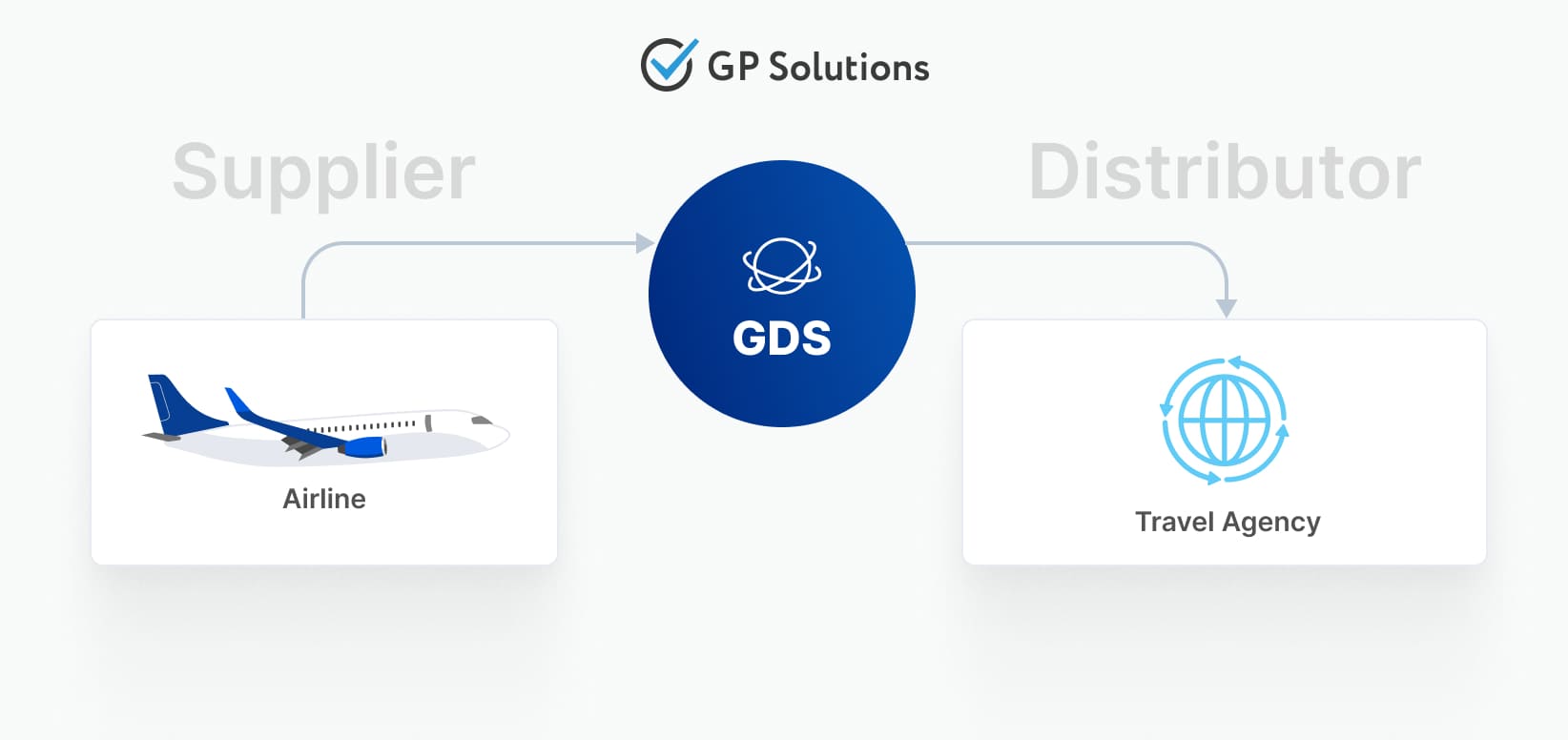
Simply put, a GDS takes content from suppliers and makes it available to distributors (travel agencies, tour operators).
Let’s take an airline (supplier) and a travel agency (distributor) as an example. GDSs are normally connected directly to an airline’s sales system — a central reservation system — software holding information about seat availability. However, apart from seat availability, we also need to know fares and schedules, which are stored in different systems supplied by third-parties — ATPCo and Innovata/OAG respectively. It would be close to impossible for travel agents to obtain those lines of information on their own, so that’s where powerful GDSs come into play, retract that info from all necessary information systems, and share it with online travel agencies for a fee.
The GDS obtains access to this data through a contract. After that, the GDS grants the access to this data to the travel agency. For instance, as a traveler, you book your flight at an agency close to your residence home. The GDS’s job here is to ensure that all the booking details are communicated to your airline’s system instantaneously. This helps avoid overbooking or inventory discrepancies — one of the major GDS features we talked about above.
Just like in an airline example, the GDS has access to many other suppliers. If you need to fly from Atlanta to Capetown, your travel agent will access hundreds of hotel, car rental, and flight options. The GDS filters all these options to give the travel agent the best set. Using the same GDS, the travel agent then books flights and reserves cars and hotel rooms. Because of the access to this vast pool of options, end users (leisure and business travelers) have access to a far richer selection of options than if they tried to do it by themselves.
Significance for the Travel Industry
GDS systems have reimagined the changing face of travel distribution by consolidating the inventory of travel service providers into a central database, which is available in real-time. As more suppliers and distributors are popping up, the need to have access to this expanding network intensifies.
When connecting to the content consolidated by GDS platforms, travel agencies and OTAs have access to a refined view of services and inventory without having to connect to multiple fragmented systems. GDS software tracks its availability, price, and rules (such as booking and cancellation policies) and opens up a favorable opportunity for travel agents to compare available options and finalize bookings for their clients.
No less important are GDSs for suppliers (airlines, hotels, and car rental companies), as they create and maintain a global multi-channel distribution network, with live updates and synchronized bookings across multiple systems. When it comes to travel services, their provider wants to maximize their visibility and resulting revenue.
GDS vs. Direct Booking Channels
First off, we need to clarify what direct bookings are. These are bookings made on airlines’ (Ryanair, Wizz Air, Lufthansa, etc.) or hotels’ (Marriot, Hyatt, or other) own websites. This option maintains a direct communication channel between a traveler and a service provider.
A GDS reservation system, on the other hand, adds scalability and breadthto the game and enables multi-segment bookingoptions for agencies that would cover flights, hotels, cars, and even rail services — all from a single entry point. In the end, complex travel itineraries are designed through a more efficient booking process.
Are There Any Cons to GDS-Centered Distribution?
Nothing is perfect, and the partnership with a GDS comes at a certain cost.
Lack of valuable customer data. GDSs process bookings, so most of the information remains in the hands of middlemen, which doesn’t allow airlines or other service suppliers to track their customers and eventually adapt their preferences.
Limited ancillary support. Airlines receive a very thin margin in the sale of their core services. The main source of profits is ancillaries — seat selection, baggage upgrades, priority boarding, on-board meal plans, etc. Yet, GDS APIs usually transport only limited ancillaries to OTAs.
No full control of their marketing strategy and no choice of a distribution channel. Offers are basically built within GDSs, when you cannot clearly see the market dynamics and traveler behavior to adapt.
Yana Brilevskaya
In the GDS ecosystem, airlines are stripped of the ability to design and deliver package offerings, special discount campaigns, and similar. That was one of the reasons why New Distribution Capability (NDC) came to life and is now actively being embraced both by airlines themselves and GDSs, who were primarily forced to do so to keep their clients.
Related Case Study
Customized Booking Automation Platform for a Global Educational Travel Company
GP Solutions helped Education First upgrade their educational travel services with a customized booking automation platform. The solution enhanced booking workflows, integrated third-party systems, and introduced a custom loyalty program, improving efficiency, scalability, and user experience.
How to Get a GDS System
Your travel business can gain access to GDSs in several ways:
Direct partnership with a GDS travel system:Large travel businesses often opt to enter into a direct agreement with GDSs. This model of cooperation is far from being easy, as, apart from higher costs, OTAs and travel agencies should take care of contract negotiations, commission structure agreements, and adherence to the provider’s technical and legal requirements.
Through third-party solutions:If you operate on a smaller scale, then your most probable choice would be to work with GDS content via third-party tech provider with integrated GDS functionality. This option comes with adjustable pricing and reduced costs.
Requirements: For the proper use of a GDS system and the content that comes with it, agencies need booking terminals and internet connectivity (technical infrastructure) and go through special training. In addition, they must attain IATA or ARC certifications if they plan to access and manage air bookings.
How Much Does a GDS System Cost?
The cost structure of using a GDS system is complex and involves several components:
Setup and integration costs: A GDS reservation system normally charges a fee when agencies proceed to the initial setup and integration into its platform. The final price tag will depend on the integration complexity and can be anything from $10,000 to $50,000.
Commission structure: GDS systems earn their money with commissions and transaction fees. When, for instance, you as a travel business book a flight via GDS, the airline will pay a commission to the GDS, which can vary from $3 to $12 per booking.
Ongoing subscription or licensing fees: $200 to $1,000 per monthis a fee your travel agency would pay for the access to the GDS content. The payment may be year- or month-based and depends on the size of the travel agency and the amount of transactions.
The final pricing is dependent on several factors such as youragency’s size, which servicesyou access, and the booking volume.
What Are the Alternatives?
If the above methods are a no-go for you, but you still need access to travel services and products, you can consider several alternative ways:
Third-party travel APIs;
Travel aggregators like Expedia or Skyscanner allow you to connect via a commission-based model;
Affiliate programs, when large booking platforms offer options to earn commissions if you book their services for your customers;
Direct partnership with suppliers;
White-label travel solutions or custom booking engines.
We are a certified development partner of Amadeus. Reach out to us to learn how you can connect to them.
Tanya
Business Development Expert
What Are the Major GDS Systems? Comparison of Amadeus, Sabre, and Travelport
The competitive landscape is still dominated by the “Big Three” — Amadeus, Sabre, and Travelport — who jointly control around 97% of the indirect booking market. However, their strategies have split sharply in 2025. Amadeus has cemented its position in Europe and Asia with its Cloud Planet migration with Microsoft Azure. Sabre has solidified its lead in the Americas by migrating 90% of its workloads to Google Cloud, which has allowed it to launch its SabreMosaic AI platform. Travelport continues to aggressively position itself as the champion of modern retailing for agencies with its focus on aggregating fragmented NDC content.
H1 2025 Revenue: Down 1.4% amid ongoing restructuring
Revenue increased in 2024 but remains below pre-pandemic levels
Market Share
Biggest GDS, market share approx. 40%
Second-largest, around 35% of the market
Holds about 25% of the GDS market
Geographic Coverage
Dominant in Europe, expands rapidly in Asia-Pacific
Strong presence in North America and the Americas
More evenly balanced across the world; top pick in niche markets
Services and Specialization
Specializes in air bookings, but increasingly focusing on non-air services such as hotel and rail
Expertise in airline IT solutions with a focus on airline revenue management
Known for its multi-segment services (air, hotels, cars). Powerful GDS for hotel and car rentals
Technology and Innovations
Active promoter of AI, mobile tech, and NDC content supporter, strong emphasis on its expanding distribution offers; heavy focus on biometrics and generative AI partnerships
Massive advances in NDC, AI-driven offers for personalized travel recommendations, mobile solutions, virtual payments, and AI
Emphasizes multi-segment bookings, develops mobile-first approach. Competent in NDC, AI, content aggregation, and agent UX
Ease of Use and Integration
Known for quick integration with CRM and ERP tools and third-party software
Platform powerful and reliable, yet you may experience less flexibility for non-airline solutions
Seamless integrations with many travel systems, user-friendly interfaces, more modern looks
Cloud Infrastructure
Microsoft Azure (Cloud Planet)
Google Cloud (90% migrated)
Hybrid/AWS
Primary Interface
Selling Platform Connect
Sabre Red 360
Travelport+
Recent Wins (2025)
High growth in Azerbaijan/Kazakhstan
Displaced Travelport at World Travel Inc.
Expanded NDC with Saudia, TAP, Royal Jordanian, Riyadh Air, Chase Travel Group, and others
Pros and Cons of Each GDS
Nothing is perfect, however elaborately it may be designed. We have compiled a brief summary of the strong and weak sides for each of the major GDS.
GDS
Pros
Cons
— Large global network covering air, hotel, and rail
— Advanced booking capabilities for air services and other types of services like hotels, car rentals, or rail trips
— Higher costs for smaller travel agencies resulting from premium features and broader service coverage
— Strong in North America, with a focus on long-lasting airline solutions
— Comprehensive tools for airline revenue management and operations
— Probable limited regional support in Europe, compared to others
— Broad booking capabilities for multiple segments (cars, hotels, etc.)
— User-friendly interface for agents and agencies specializing in diverse services
— Fewer exclusive agreements with air carriers, limited air inventory compared to others
How to Choose a GDS System?
Which partner will be the best GDS system for your particular travel company largely depends on several parameters:
Business size
Type of services you offer
Target market
We’ve compiled a breakdown guide to make your path towards the right choice a bit easier.
Business Size
Large agencies: World-scale distributors (Sabre, Amadeus, or Travelport) are a frequent choice for large OTAs. They boast wide global reach, expansive networks, multiple booking management tools, ERP and CRM integrations, and, of course, fully-fledged booking opportunities. The number of bookings via a large agency’s environment allows it to absorb higher transaction fees and initial setup spendings.
Small agencies: Services of a major GDS may challenge a smaller agency’s or a startup’s budget. To get the most of GDS data and not to overpay for it, such businesses resort to third-party solutions that have already integrated GDS services. Overhead costs are considerably lower for such scenarios. For instance, Travelport, may be a source of flexible options for smaller-scale companies.
Type of Travel Services Offered
Air-focused services: If you are the one into air travel, your practical choices would be Amadeus and Sabre. No other GDS is more dominant in the air travel sector than these two.
Multi-segment services: Need air, car, and hotel content in one place? Consider Travelport with its particular emphasis on parallel bookings for multiple segments.
Niche services: First of all, what are niche markets? In travel, these can be rail travel services, corporate travel, or luxury tours. The choice for you here largely depends on the budget you are ready to spend. Available options can be found on the Amadeus or Travelport platforms that have been developing tools for these segments.
Geographic Region
The market power of GDS systems is not uniformly distributed throughout the world.
North America is Sabre’s strategic stronghold. The GDS has a global market share of about 30–35%, but a disproportionately higher one in the US and Canadian agency markets. The region is known for high rates of corporate booking tool adoption and advanced agency workflows. In 2025, Sabre’s expansion in this region is partly attributed to the acquisition of major agency business, for example, the account of World Travel, Inc., displacing competitor Travelport.
Europe, the Middle East, and Africa (EMEA) remain the fortress of Amadeus. Headquartered in Madrid, Amadeus has a global market share of nearly 40% and is the backbone for most of the European national carriers. The European market in 2025 is greatly shaped by the regulatory push for sustainability, as well as by the commercial pressure for NDC adoption from companies such as Lufthansa and Air France-KLM. How effectively Amadeus can integrate such fragmented content streams lies at the core of its prominence in the region.
Asia-Pacific (APAC) has emerged as the most dynamic new frontier of growth. Amadeus has identified an Asia Uplift as one of the crucial trends for 2025, with notable increases in booking volume in new destinations such as Azerbaijan (26% increase) and Kazakhstan. The region is experiencing a revival in outbound travel from China and India, markets where GDS providers need to adapt to local payment ecosystems and mobile-first booking behaviors. The growth in this region is also contributing to the adoption of cloud-based systems.
Travelport does business in multiple regions and can be characterized as a balanced global player.
Related Article
Sabre API Integration: An Intro Guide to the Top-Tier GDS
Expand your reach with Sabre API! Discover how this powerful tool connects you to global travel inventory for flights, hotels, and more.
The Tech Revolution: What’s Next for GDSs?
The financial contours of the Global Distribution System sector show a market that is in the midst of a significant upcycle. While the market size was valued at USD 6.7 billion in 2024, the aggressive integration of AI and cloud technologies multiplies value, providing the grounds to project the market size at USD 16 billion by the end of the decade.
This steady growth is supported by three structural drivers:
Globalization: The need for standardized and compliant travel management platforms that can function across borders.
Tech overhaul: In 2024 alone, more than USD 850 million has been invested in technological upgrades by GDS providers, specifically focusing on API-based integrations and predictive analytics.
The ability to provide value by a GDS is no longer defined by its network size but by the agility of its software to adapt to the rapid innovations and the latest tech trends in the sector and the top management — to see a greater picture behind such developments:
01
The Infrastructure Wars: Cloud and Artificial Intelligence
The migration of legacy mainframes to public cloud environments is the defining technological achievement of the first half of the decade, opening the doors for generative AI and data processing in real time. The Big Three have partnered with different hyperscale providers, forming different technology ecosystems.
Sabre and Google Cloud: Sabre has done a massive re-platforming and moved almost 90% of its workload to Google Cloud (over 40,000 servers and 50 petabytes of storage). Using Google’s own data analytics tools, such as BigQuery and Vertex AI, Sabre launched SabreMosaic. This modular platform allows airlines to dynamically create and price offers based on real-time traveler intent, which can result in faster search response times and increased relevance in search results using sophisticated algorithms.
Amadeus and Microsoft Azure: As part of its Cloud Planet initiative, Amadeus has worked with Microsoft Azure to re-engineer some of the most fundamental applications, like the Cytric booking tool, to run natively on the cloud. A key strategic differentiation is integrating booking capabilities directly into corporate tools such as Microsoft Teams, which reduces friction and transitions over 50% of apps to a more robust and scalable environment.
02
Artificial Intelligence: From Chatbots to Agents
Artificial intelligence in GDS systems has graduated from experimental customer service chatbots to core operational engines. The focus has moved to Agentic AI — autonomous software agents that can execute complex workflows.
GenAI for itinerary creation: Generative AI tools integrated within GDS software let users type in complex natural language input (e.g., “Create a two-week itinerary for a family of four in Japan, with the theme of anime culture and ryokan stays”) and receive a fully bookable itinerary within seconds. This capability moves the system function from a simple data entry function towards high-level consultation and planning.
Predictive disruption management: AI agents are now continuously monitoring the global travel environment and processing signals from weather reports, labor strikes, and geopolitical news to predict flight cancellations before they officially occur. This enables “trip repair” — proactive re-accommodation to remove operational chaos.
Continuous pricing: AI algorithms are behind continuous pricing, where airlines provide fares outside the standard of 26 booking classes (A-Z). Prices are computed dynamically in real time based on context (who is asking, when, and through which channel) and can lead to infinite price points and optimal revenue management.
03
The NDC Paradigm Shift
New Distribution Capability (NDC) has been making waves since 2015, when IATA introduced this new API standard for airlines. NDC empowers airlines to build their own APIs to connect to GDSs or bypass them entirely and connect directly to OTAs. With more than 60% of the airlines using the standard, it has become a commercial imperative.
The legacy EDIFACT protocol is efficient for simple transactions but limited in its ability to transmit rich product attributes such as seat pitch, meal photos, or Wi-Fi availability. NDC (XML/JSON) facilitates rich content distribution that will allow airlines to be true retailers. This helps with dynamic offers and bundled ancillaries, opening up price points that in many cases are much cheaper than legacy EDIFACT fares.
To expedite the move towards NDC, major airline groups have adopted different commercial models, with some offering lower fares for NDC-enabled bookings.
The fragmentation created by NDC, where the airlines limit the content to specific channels, has opened a market up for aggregators, often called “GDS 2.0.” Companies such as Travelfusion, Duffel, and Verteil use API-first connectivity to bypass legacy mainframe architectures. These entrants offer travel companies a way to access LCC and NDC content without the technical debt of the legacy GDSs.
Travelfusion: Integrates with more than 150 Low-Cost Carriers (LCCs) and full-service airlines through Direct Connect APIs, filling in the inventory gaps that exist in the traditional GDS coverage.
Duffel: Lowers the barrier to entry by abstracting the complexity of individual airline APIs into one, allowing digital-first players to create custom booking engines without arduous certification processes.
Verteil: Focuses on the servicing gap in NDC, providing solutions that allow for the management of complex post-booking scenarios (changes, refunds), which remain an operational hurdle in the NDC.
05
ONE Order: The End of the PNR
IATA’s ONE Order initiative is aimed at retiring legacy artifacts such as the Passenger Name Record (PNR), the Electronic Miscellaneous Document (EMD), and the Electronic Ticket (ET). By 2028-2030, these will be replaced by just one, retail-style “Order” record. This will unify flights, hotels, and ancillaries into a single system entry, drastically simplifying back-office accounting and reconciliation across the industry.
06
Sustainability as a Data Standard
Due to increasing environmental regulations, data on sustainability is now a common field in GDS search results. In the near future, the functionality to display and sort according to carbon footprint when buying at the point of purchase will likely be a standard requirement of all distribution platforms. GDS providers are currently standardizing this data ingestion, allowing operators to filter and sort results by “Lowest CO2” with the same ease as sorting by “Lowest Price”.
07
The Agentic Web
The convergence of generative AI and API connectivity is leading to the Agentic Web. In this near-future scenario, a personal AI assistant for a traveler may be able to negotiate directly with an AI agent on the travel company’s side to create a customized trip, using headless APIs to avoid human-readable interfaces altogether.
No travel company can function on its own.
Let us help you with your third-party integrations.
Even though airlines, hotels, and other local service providers seek to avoid third parties and distribute their product directly, they will look for a reliable booking platform with the richest selection of options. Victory in the competition will go to the one that can book faster and better for their end customers — travelers.
At the moment, connecting to GDS content is one of the wisest choices for many travel agencies. Yet, the choice strongly depends on your particular business, so tread with caution. Or you can always resort to GP Solutions for tech consulting and implementation.
Anastasia Borodinets
Travel Technology Expert at GP Solutions
Subscribe to our blog
Contents:
Subscribe to our newsletter
Join us in our social media resources
Thank You!
Your subscription has been confirmed. You’ve been added to
our list and will hear from us soon.
Embark on a digital odyssey in travel! Discover how tech innovations like AI and IoT are reshaping the journey, making travel seamless and personalized.
Our tech expert explores the vast landscape of travel APIs, major selection criteria for businesses, and the integration process with all its risks and challenges.