API and integration layer: GraphQL, Apollo Federation, gRPC, SOAP, REST (HTTP)
Data and storage: MSSQL, MySQL, MongoDB, Redis (including Redisson client), Elasticsearch
Front end: React (including Hooks), Next.js, TypeScript, JavaScript, Apollo Client (GraphQL), Bit.dev, RebassJS, Jest
Content management (CMS): Cloud CMS, REST API
DevOps and infrastructure: Kubernetes, Docker
Observability and monitoring: Prometheus, Grafana, OpenTelemetry, Loki, Sentry.io
Cooperation Period
6+ years (ongoing project)
Client Background
Headquartered in Zurich, Switzerland, Hotelplan Group is the largest and one of the most prominent European tour operators. The Group manages a full spectrum of travel services that include flights, hotels, dynamic packages, round trips, car rentals, cruises, transfers, and more, which makes it the cornerstone of the DACH region’s travel industry. As a rapidly growing company, Hotelplan faced the need to move from a traditional business model to a tech-first powerhouse in order to keep pace with their expanding software needs.
Why GP Solutions?
To implement a transformation of this scale, Hotelplan needed more than just developers. They were looking for a strategic technology partner and chose GP Solutions for our:
Deep domain expertise and firsthand knowledge of complex travel software ecosystems;
Access to full-cycle dedicated specialists, including front- and back-end developers, system architects, DevOps engineers, UI/UX experts, business analysts, and QA professionals;
Same time zone support that enabled continuous, high-velocity development.
Project Goals and Challenges
Before GP Solutions joined the project, Hotelplan’s digital infrastructure was stumbling under the burden of technical debt. Their legacy environment was characterized by:
Monolithic inefficiency: The company operated several websites built as monolithic applications. Due to the tight coupling of the front end and the back end, code was often copy-pasted across them. This lack of modularity required developers to manually replicate a single update multiple times, which severely reduced time-to-market.
Scalability barriers: The PHP-based monoliths were hard to scale during peak booking seasons, causing high operational risks.
Manual friction: A complete lack of automated testing meant each release would need to undergo a massive amount of manual QA, causing a high likelihood of errors and deployment delays.
Fragmented content management: The CMS Hotelplan used at the time was not intuitive, did not offer bulk update capabilities, and was weighed down by legacy code, which made it impossible for content managers to respond to market changes in real-time.
Integration debt: With no centralized middleware, every new project had to independently reintegrate with third-party services, resulting in massive redundancy.
Why Custom Development?
While off-the-shelf solutions were considered, Hotelplan chose a 100% custom-built infrastructure. The decision was based on four critical factors:
Extreme integration complexity: Hotelplan’s ecosystem comprised a high volume of data sources (CMS, Hapi, Peakwork, and a number of internal export systems). There was no ready-made solution that could natively achieve harmonization between these without significant, costly workarounds.
Customization needs: Off-the-shelf products would require significant modifications to meet their requirements, making customization just as time-consuming and costly as building from scratch.
Strategic independence: Ready-made products often come with a rigid roadmap. With custom software, Hotelplan got the freedom to innovate without waiting for third-party approvals or vendor-constrained functionality.
Future-proofing: Custom architecture eradicates compatibility issues during updates, which means that as the travel industry evolves, the software will be able to adapt immediately.
Project Goals
The mission was to shift from the brick-and-mortar IT mindset and create a high-performance digital engine. Key goals included:
Infrastructure modernization — Replacing the monoliths with a scalable microservice-based back-end system.
Conversion optimization — Redesign of the booking flow for speed, efficiency, and mobile-first responsiveness.
Operational cost reduction — Developing reusable components that could be shared across all company divisions.
Agile content handling — Implementing a flexible CMS (Cloud CMS) for content management to handle bulk updates.
Unified API integration — Creating a powerful middleware layer to aggregate the APIs from travel suppliers and ensuring a smooth flow of data across all touchpoints.
Project and Its Development
In order to bring a giant like Hotelplan into the digital age, GP Solutions embedded a special hybrid team that functioned as a natural extension of the client’s own internal IT department.
We deployed two special squads for both the complexity of the travel customer journey and breadth of the Hotelplan portfolio:
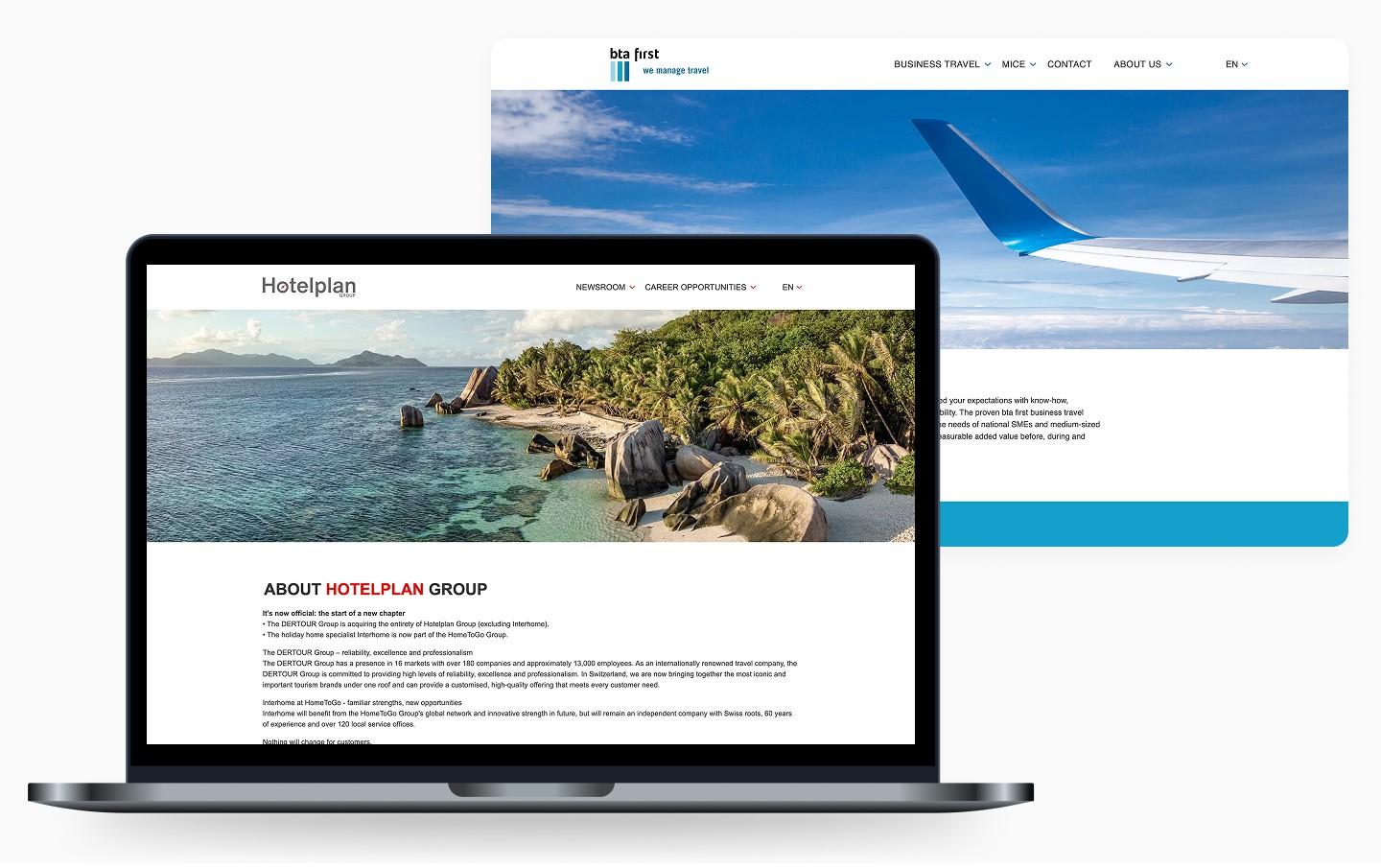
The Feature team focused on the constant development and support of the brand’s multi-site portfolio that includes BTA First, Vtours, Hotelplan, Travelhouse, Migros Ferien, and Hotelplan Group Corporate.
The Checkout team was dedicated only to the post-booking phase, the most important part of the conversion funnel, where technical precision and transaction security are of critical importance.
The project also required a dedicated Automation QA lead from GP Solutions to manage the process of changing from manual checks to a full CI/CD pipeline.
The entire project was implemented in several phases.
Phase 1: Fundamentals and The Hotelplan.ch Redesign
The first major milestone was to totally overhaul a flagship brand, hotelplan.ch. This was to become the blueprint for the modernization of the entire group. Major changes included:
Unified back end and industry standards: We replaced multiple site-specific back ends with one unified back end. This created a single centralized point of entry for all third-party integrations, which reduced the maintenance overhead drastically.
Cutting-edge stack: We’ve migrated the infrastructure to a modern stack: React.js, Apollo Client, Node.js, and GraphQL.
API integrations for travel suppliers were applied according to Hotelplan’s specific requirements.
Microservices and Cloud CMS: We integrated a flexible and microservice-based Cloud CMS. Now marketing teams can update their content in real time without the need to involve a developer for code deployment.
Universal booking logic: We designed an end-to-end booking flow which consolidated complex products such as flights, hotels, dynamic packages, car rentals, and cruises into a single and high-performance interface.
Phase 2: Scaling Innovation
After the launch of the flagship, we turned our attention to scaling these efficiencies across all the Group’s brands.
1. Back End
Speed to market:We introduced Apollo Federation, a common technology employed by industry leaders for decoupling services. It allows the independent development of various services, i.e., new features can be implemented for all the websites at the same time.
Observability: We used Grafana and Prometheus to enable real-time monitoring of logs and traces, which is key for running a high-load microservice architecture.
Containerization: Legacy services were dockerized and moved to a common architectural standard, which provided consistency across the environment.
Customized travel integrations: We created custom connectors to integrate several third-party services.
2. CMS: Multi-Tenancy and UI Customization
Instead of the usual CMS templates, we created a universal content model to support all the client’s brands (tenants).
Content automation: We implemented automated ingestion of data from external subsystems.
Tailored UI: We adjusted the CMS interface specifically for Hotelplan’s content editors and added bulk update and special search features.
3. Front End: Reusable Component Library
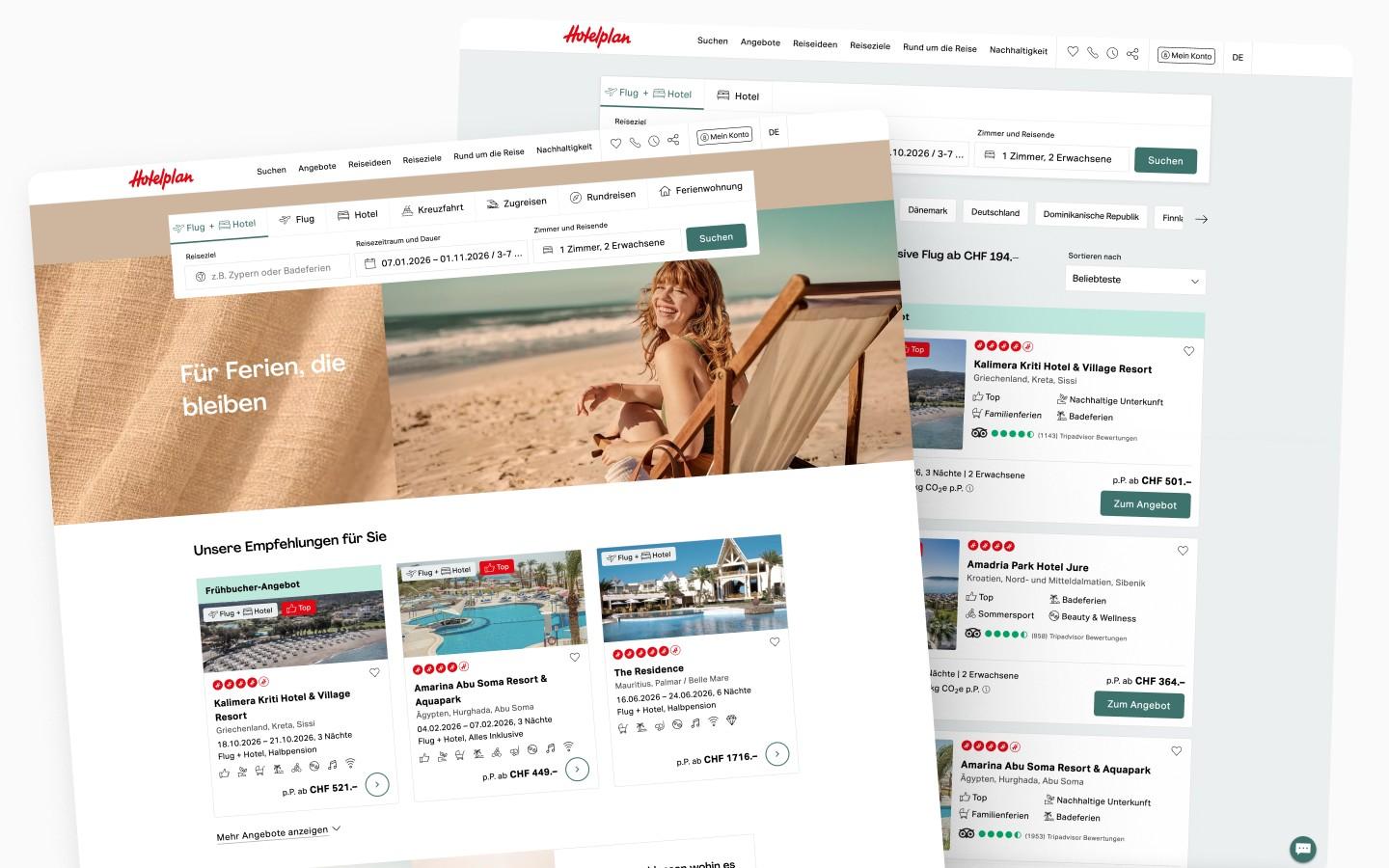
We redesigned the client’s complete website portfolio. To ensure that we have design consistency and speed, we utilized bit.dev to store a shared library of common components.
Performance optimization: We optimized the dynamic component rendering logic, and the load times are lightning fast even with complex filtering and search results.
Next.js migration: Migration is an ongoing process as applications are being migrated to the latest version of Next.js to get the benefit of better SSR and better SEO.
Phase 3: From Zero to 5,000+ Automated Tests
At the time we joined, testing was all done by hand. Our team built a complex and custom testing framework from scratch to test the stability of the system.
Custom framework: Based on Wd-io + Cucumber (UI) and Jest + Supertest (API) in JS/TS.
Speed gains: A conventional testing framework takes generally 3 months to implement but using our proprietary approach, we implemented the UI framework in 2 weeks and the API framework in 1 month.
Coverage: We were able to achieve between 64% to 78% test coverage on 7 different projects with the focus on dynamic components, as they are most likely to change.
Current scale: The system now runs more than 5000 automated backend and 250+ front-end scenarios to make sure that every release is stable.
The Resulting Ecosystem
Today, GP Solutions oversees and has modernized the entire digital face of:
The modernization of Hotelplan Group’s infrastructure went beyond just updating their code, fundamentally changing the way they did business.
Efficiency Gains
The shift to a unified architecture and reusable component library delivered immediate, measurable results:
Rapid time-to-market: The development and updates to new websites accelerated drastically, thanks to the use of the pre-built, shared component library (bit.dev).
Reduced development costs: By moving multiple fragmented back ends to one unified entry point, Hotelplan greatly reduced long-term maintenance costs and simplified support processes.
Onboarding velocity: The unified tech stack across all brands has reduced the barrier to entry for new engineers so that they can contribute to any of the Group’s projects with minimal ramp-up time.
Technical Scalability and Operational Excellence
The transition from monoliths built in PHP to a reactive architecture based on microservices changed the way the client’s system deals with load and updates:
Elastic scalability: Thanks to Kubernetes, the system is now able to scale the number of replicas of particular services with one line of code, ensuring 100% stability during the peak seasons of bookings or high-traffic promotions.
Zero-downtime releases: With a continuous delivery pipeline and 5,000+ automated tests, Hotelplan is now able to release at a large scale with confidence, minimizing disruptions to business continuity.
High-performance integration: The replacement of the legacy SOAP APIs with REST APIs and the introduction of reactive programming and Redis-based caching (including RediSearch) enabled the system to handle the high load of data requests from Peakwork and the CMS with lightning speed.
Enhanced User Experience and Market Recognition
The success of the project was not only confirmed by internal metrics, but also by the market and industry peers:
Award-winning quality: The redesigned hotelplan.ch entered the shortlist for the prestigious Best of the Swiss Web award.
Record-breaking traffic: After the release, the website had its greatest number of visitors in a day ever, and the number is steadily rising.
Superior UI/UX: Travelers now have a more intuitive, dynamic, and faster booking experience. Features such as in-line content configuration and optimized search/filtering have led directly to higher conversion and customer satisfaction.
CMS Innovation for the Content Team
The custom-tailored Cloud CMS transformed content management from a bottleneck into a competitive advantage:
AI-enhanced bulk imports: Imports of large amounts of data (hotels, geo-objects) are now possible from Excel, with the possibility to use AI for information generation and bulk update, which was impossible earlier.
Total content control: The introduction of inline configuration enabled editors to set up entire pages in a single view, which massively speeds up the implementation of marketing campaigns.
The cooperation between Hotelplan Group and GP Solutions transformed a complex legacy environment into a marvel of technology for the travel industry. By focusing on reusability, automation, and architectural unity, Hotelplan is now able to take the lead in the market, responding to new trends in days rather than months.
Marc Blaser, Director Projects, Hotelplan Management AG, Switzerland
“GP Solutions’ expertise in travel-oriented development and their team’s wide range of skills have been huge for us. Engage their people as soon as possible within your project timeline. Their Travel Technology Division has a fantastic level of expertise on all development fronts that will help your project get moving quickly.”